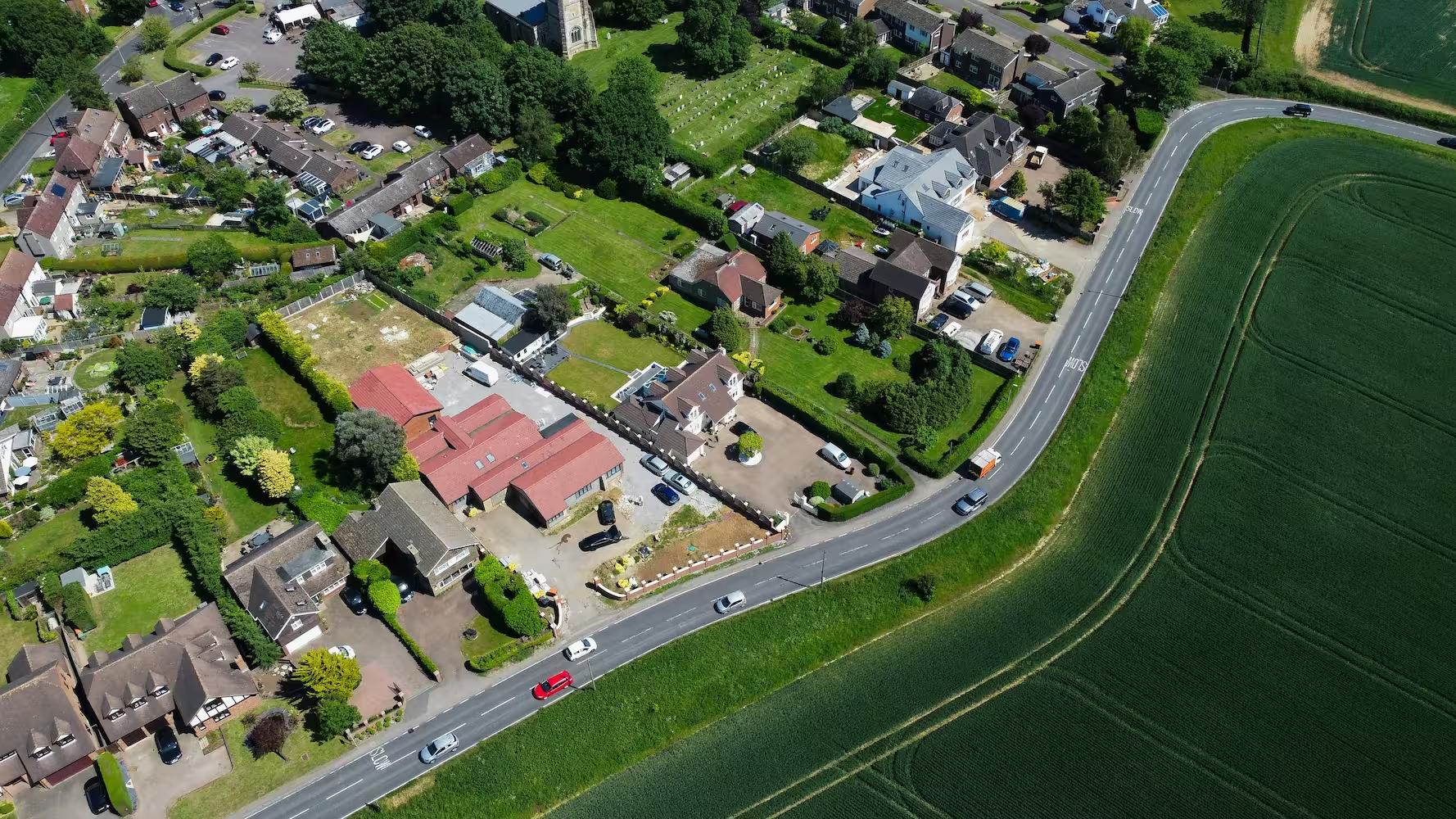
The government's "grey belt" policy, launched just over a year ago with the promise of unlocking brownfield development sites, is not delivering on its stated objectives. Instead, new research from the CPRE (Campaign to Protect Rural England) reveals a troubling reality: 88% of homes approved under the scheme are being built on previously undeveloped green belt countryside, much of it Grade 1 farmland that represents some of the most productive agricultural land in the country.
For landowners, farmers, and anyone concerned about the future of British food production and rural economies, this development carries significant implications—and opportunities.
The Gap Between Promise and Reality
When Labour came to power, the grey belt policy was presented as a solution to England's housing crisis without sacrificing the countryside. Prime Minister Sir Keir Starmer himself promised that the government would "prioritise ugly, disused grey belt land" such as old petrol stations, derelict industrial sites, and abandoned car parks. The framing was clear: brownfield before countryside.
The reality tells a different story. Since December 2024, government planning inspectors have approved 13 major schemes across the green belt, frequently overruling local councils and farming communities who objected to the loss of agricultural land. Of the 1,250 homes approved so far, almost nine in ten are destined for land that has never been built on before—including some of England's most valuable farmland.
The CPRE's analysis is particularly damning when examined case by case. In Tonbridge, Kent, 57 homes are scheduled for construction on Grade 1 farmland—the highest classification for agricultural soil quality. In Castle Point, Essex, 47 homes have been approved on land that forms part of a Local Wildlife Site and contributes to ecological networks essential for sustainable farming practices. Both sites previously enjoyed green belt protection before being reclassified as grey belt.
Why This Matters for Landowners
For landowners with agricultural property, this policy represents a fundamental shift in how development pressure is being applied to rural land. The traditional green belt protections that have guided planning decisions for decades are being weakened in favor of a vaguely defined "grey belt" category that appears to offer little genuine protection.
What does this mean in practical terms? Landowners with green belt land may find themselves increasingly exposed to development proposals and planning pressure, even if their land is actively farmed and economically productive. The distinction between "truly undeveloped" and "available for development" is becoming dangerously blurred, particularly when planning inspectors can override local authority decisions.
The contradiction is striking: CPRE's recent State of Brownfield report identified capacity for 1.4 million homes on previously developed sites—almost half already with planning permission. The land exists. The planning permission exists. Yet developers and planning inspectors continue to target virgin farmland instead. As CPRE's policy lead Emma Marrington noted, this represents "a choice, not a necessity."
For landowners, the question becomes: If genuinely brownfield land could supply far more of England's housing needs, why is prime agricultural land being targeted? The answer appears to be profit margins. Developing pristine farmland on the edges of towns is often simpler, cheaper, and more lucrative for large housebuilders than remediation of contaminated brownfield sites.
The Farming Economy Under Pressure
British farmers are facing an unprecedented confluence of pressures: input costs, volatile commodity prices, changing subsidy regimes post-Brexit, and now the loss of productive land to speculative development. The farmland being targeted by grey belt approvals isn't marginal or underutilized—it's actively productive, supporting viable farm businesses and contributing significantly to local agricultural economies.
Grade 1 farmland—the classification applied to the Tonbridge development—represents less than 3% of England's land area. Losing it to housing development isn't just an agricultural issue; it's a food security issue. As the CPRE emphasizes, once this land is gone, it's gone for good.
The knock-on effects ripple through rural communities. Smaller farms become less viable when surrounded by development. Agricultural contractors find it harder to operate efficiently. Supply chains for local food production become fragmented. The countryside transforms from a landscape of managed food production to one of isolated pockets of farming surrounded by suburban sprawl.
The Contradiction at the Heart of Government Policy
Here lies the central tension: the government has committed to protecting 30% of land for nature by 2030, yet the grey belt policy is directly undermining this goal by allowing development on land that forms part of ecological networks and wildlife corridors. Farmland isn't just about food production—it's an interconnected landscape that supports biodiversity, carbon storage, water management, and countless ecosystem services that benefit the entire country.
Roger Mortlock, CPRE's chief executive, has described the grey belt policy as "an existential threat to the protections of the green belt." He's also criticized it as "vague, subjective and misleading to the public"—characterizations that are difficult to dispute given the gap between the policy's stated intent and its actual implementation.
The vagueness is the problem. When planners can't clearly distinguish between legitimate brownfield opportunities and speculative greenfield development, the incentives naturally favor the easier, more profitable option. And with planning inspectors overruling local councils, the voices of farming communities and elected representatives are being systematically sidelined.
What Needs to Change
The CPRE's recommendations are straightforward: tighten the definition of grey belt so it applies only to genuinely previously developed land. This would protect food-producing farmland and wildlife habitats from speculative development while still delivering the housing that England genuinely needs—on the brownfield sites where it can be delivered more efficiently.
Additionally, the CPRE calls for legally binding targets for affordable and socially rented housing, with genuine accountability for developers who fail to deliver these commitments. If developers are going to be given access to pristine farmland, shouldn't we at least ensure they're solving the housing crisis with genuinely affordable homes rather than boosting their margins with premium developments?
The Broader Implications for Land Strategy
For landowners, this policy uncertainty creates both risks and considerations. Land that was once considered safely protected by green belt status can no longer be relied upon to retain that protection indefinitely. Equally, the revealed preference of planners and developers for virgin land over brownfield sites suggests that proximity to development pressure, planning history, and local authority boundaries will become increasingly important factors in land valuation and strategy.
Understanding these shifting dynamics is crucial for anyone with significant landholdings. The rules of the game are changing, and staying informed about planning trends, policy development, and market pressures is essential.
Conclusion
The grey belt policy was supposed to be about smart development—prioritizing already-damaged land over pristine countryside. Instead, it's become a tool for weakening rural protections and making it easier for developers to target precisely the farmland that should be most precious to a nation concerned about food security and environmental protection.
For farmers, landowners, and anyone who cares about the future of the British countryside, this represents a significant threat. The good news is that the policy can still be reformed—the CPRE's recommendations are clear and achievable. The question is whether the government will listen before more irreplaceable farmland is lost.
Stay Informed About Land and Property Opportunities with Landlister
If you're a landowner, farmer, or property professional navigating England's changing planning landscape, understanding what's happening to farmland values, development pressures, and land use patterns is essential for strategic decision-making.
Landlister is the UK's leading platform for land sales, bringing together buyers and sellers of land across England with transparency and market intelligence. Whether you're looking to understand current market conditions for your own landholdings, explore opportunities to acquire undervalued farmland, or simply stay informed about what's happening in your local area, Landlister provides the insights and connections you need.
Access real-time listings of available land, connect directly with motivated buyers and sellers, and tap into a community of farming professionals, developers, and land investors who understand the nuances of the current market. With Landlister, you're not just buying and selling land—you're gaining strategic advantage in a rapidly changing landscape.
Visit Landlister Today and Discover Your Land's Potential – because in uncertain times, knowledge and access to the right market is everything.